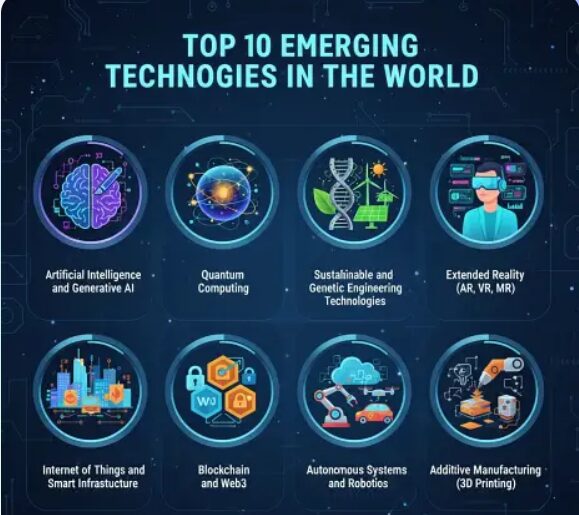
Emerging Trends (2025–2026 Outlook)
The IT landscape is currently undergoing a massive shift from “passive tools” to “active agents.”
Agentic AI: We are moving beyond AI chatbots that just answer questions. “Agentic AI” refers to autonomous software agents that can reason, plan, and execute multi-step workflows to achieve a goal with minimal human intervention (e.g., an AI that not only writes an email but finds the recipient, schedules the meeting, and updates the CRM).
Green Computing & Sustainable Tech: As data centers consume vast amounts of energy (driven by AI demand), there is a critical focus on energy-efficient hardware, liquid cooling, and software that optimizes carbon footprints.
Edge Computing: Instead of sending all data to a central cloud server, processing is moving “to the edge”—closer to where data is generated (like inside a smart car or a factory robot). This reduces latency and saves bandwidth.
Digital Sovereignty: Nations and organizations are increasingly building their own localized cloud infrastructures to ensure their data isn’t subject to foreign laws or outages.
Quantum Security: As quantum computing gets closer to reality, IT security is beginning to migrate toward “post-quantum cryptography” to protect data against future quantum decryption.
The Core Pillars of IT
IT is generally divided into several key pillars that work together to support information systems.
Hardware: The physical equipment. This includes personal computers, servers, storage units, routers, switches, and increasingly, IoT (Internet of Things) sensors.
Software: The instructions that tell the hardware what to do.
System Software: Operating systems (Windows, Linux, macOS) that manage basic functions.
Application Software: Tools users interact with (databases, email clients, CRM systems, mobile apps).
Networking: The web of connections that allows systems to communicate. This involves the internet, intranets, VPNs, and the protocols (like TCP/IP) that govern data transfer.
Data Management: The practice of storing and organizing data so it is accessible, accurate, and secure (e.g., SQL databases, cloud storage buckets).
Security (Cybersecurity): The protocols and tools used to defend the other four pillars from malicious attacks, unauthorized access, and data breaches.

Key Career Paths in IT
The field offers diverse roles ranging from highly technical coding jobs to managerial positions.
| Role | Focus | Key Skills |
|---|---|---|
| Software Developer | Building applications and systems. | Python, Java, C++, Agile methodology. |
| Network Administrator | Managing day-to-day network operations. | Cisco routing, firewalls, LAN/WAN, subnetting. |
| Cybersecurity Analyst | Protecting systems from threats. | Ethical hacking, intrusion detection, compliance (GDPR/HIPAA). |
| Cloud Architect | Designing cloud computing strategies. | AWS, Azure, Google Cloud, Docker, Kubernetes. |
| Data Scientist | Extracting insights from complex data. | SQL, Machine Learning, R, Data Visualization. |
| DevOps Engineer | Bridging development and IT operations. | CI/CD pipelines, automation tools (Jenkins, Terraform). |