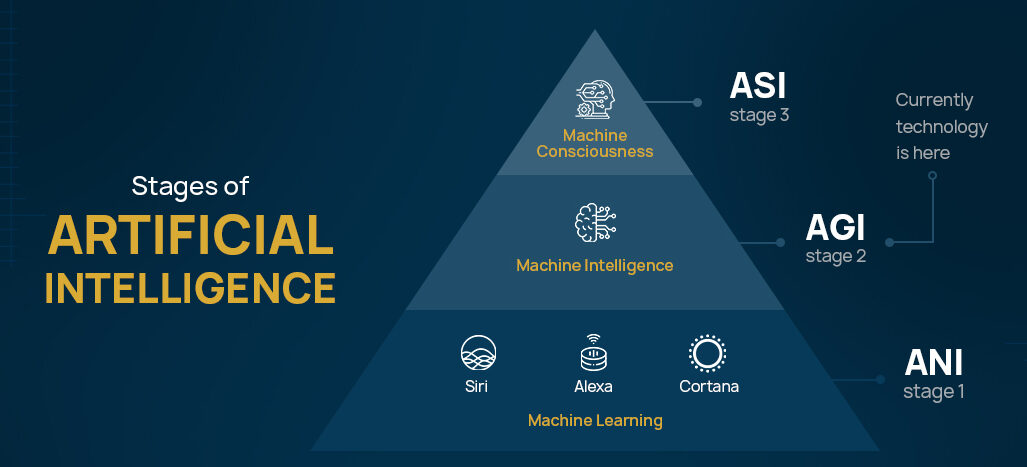
AI is generally categorized into three stages of evolution. We are currently in the first stage, transitioning toward more advanced capabilities.
Artificial Narrow Intelligence (ANI): This is where we are today. ANI is exceptional at specific tasks—playing chess, recommending movies, or generating text (like ChatGPT)—but it cannot operate outside its defined parameters.
Artificial General Intelligence (AGI): This is the future goal. AGI refers to a system with human-level cognitive abilities, capable of understanding, learning, and applying knowledge across a wide variety of unfamiliar tasks.
Artificial Superintelligence (ASI): This is hypothetical. ASI would surpass human intellect in every field, from creativity to scientific problem-solving.
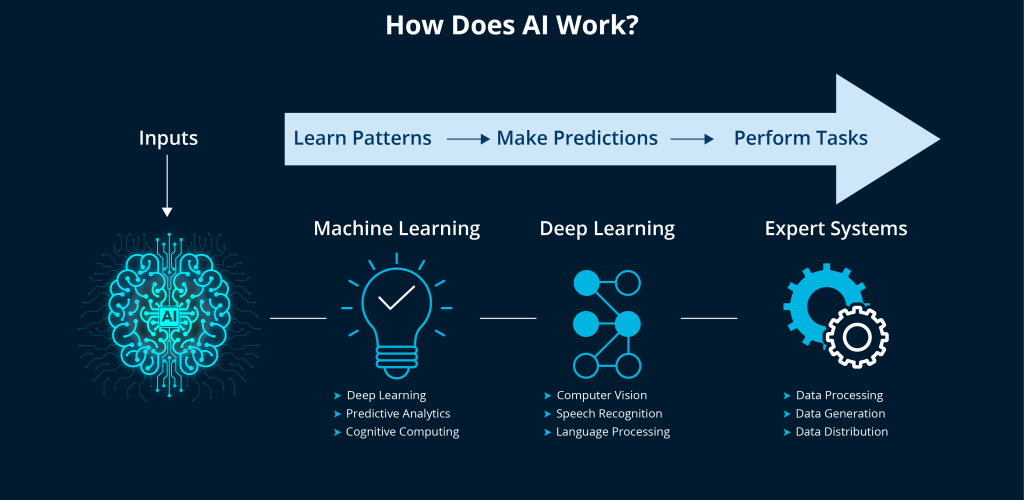
Modern AI is largely driven by Machine Learning (ML), where computers learn from data rather than being explicitly programmed for every rule.
Machine Learning (ML): The broader field where algorithms parse data, learn from it, and make a determination or prediction.
Deep Learning (DL): A specialized subset of ML inspired by the human brain’s structure. It uses Neural Networks with many layers to analyze complex patterns (like recognizing a face in a photo).
Generative AI: The most recent breakthrough. Instead of just analyzing existing data, these models (like GPT-4 or Gemini) can create new content—text, images, code, and audio—by predicting patterns they learned during training.
We are currently witnessing a shift from “Chatbots” to “Agents.”
Agentic AI: 2025 is largely defined by the rise of AI Agents. Unlike a chatbot that just answers questions, an Agent can take action. It can plan a workflow, browse the web, use software tools, and execute a multi-step task (e.g., “Plan a travel itinerary and book the flights”) with minimal human oversight.
Multimodal Systems: AI is no longer just text-based. Leading models can now process and reason across text, images, audio, and video simultaneously (e.g., showing an AI a video of a broken appliance and asking how to fix it).
Scientific Discovery: AI is being used to simulate protein structures for drug discovery and model complex climate scenarios, accelerating scientific progress at an unprecedented rate.
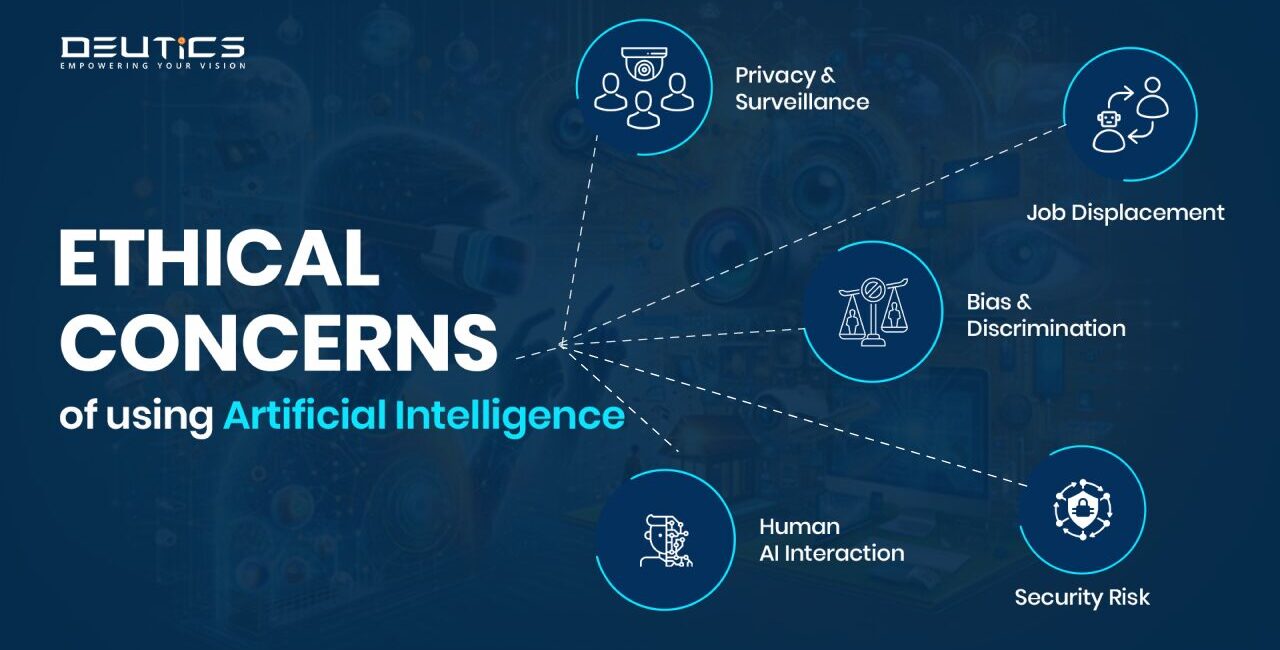
As AI becomes more powerful, the ethical stakes rise.
Bias & Fairness: AI models learn from human data, which often contains historical biases. This can lead to unfair outcomes in hiring, lending, or law enforcement.
The “Black Box” Problem: Deep learning models are often so complex that even their creators cannot fully explain why the AI made a specific decision.
Misinformation: The ability to generate realistic text and images at scale makes it easier to spread false information (deepfakes).
Economic Impact: While AI creates efficiency, it also threatens to displace jobs, particularly in knowledge work (coding, writing, customer service), requiring a societal shift in skills and education.